November 12, 2024 · Jan Hoppe
Model Explainer & Book Review: Playing to Win – How Strategy Really Works
What is the Playing to Win framework? And from a digital product management perspective, is A.G. Lafley and Roger L. Martin’s book worth reading in full? I cover both in this article!
A.G. Lafley, Roger L. Martin (2013). Playing to Win: How Strategy Really Works. Harvard Business Review Press. €22.99
German edition: A.G. Lafley, Roger L. Martin (2024). Playing to Win: Wie Strategie wirklich funktioniert. Vahlen. €29.80
Prices as of November 2024
What actually is strategy? In my experience, this question gets surprisingly ambiguous answers. For one thing, the definition varies enormously between organizations; for another, even within a single organization, different stakeholders often have their own views. For one person, strategy means setting goals; the next understands it as the synergistic interplay of different functions; and for others still, strategy is adapting to changing market conditions. So it’s hardly surprising that only a few people in our community can spontaneously name practical examples of how they apply strategy in their work.
Time to close that gap. In Playing to Win: How Strategy Really Works, former Procter & Gamble CEO A.G. Lafley and serial business author Roger L. Martin take on exactly this topic. How they do it, whether their approach helps in digital product management, and whether the book is worth reading – you’ll find out in the following paragraphs.
The ‘Playing to Win’ Framework Explained
“Strategy can seem mystical and mysterious. It isn’t. […] It is a set of choices about winning. […] These choices and the relationship between them, can be understood as a reinforcing cascade.” The authors propose answering five clear, sequential questions to gain strategic clarity. This concrete, well-thought-out approach breaks through the uncertainty about strategy I described in my introduction: answer five questions, and you have the answer to what your strategy is. Because these questions form the core of the Playing to Win framework, and answering them produces an individual strategy, I’ll go through them in detail here.
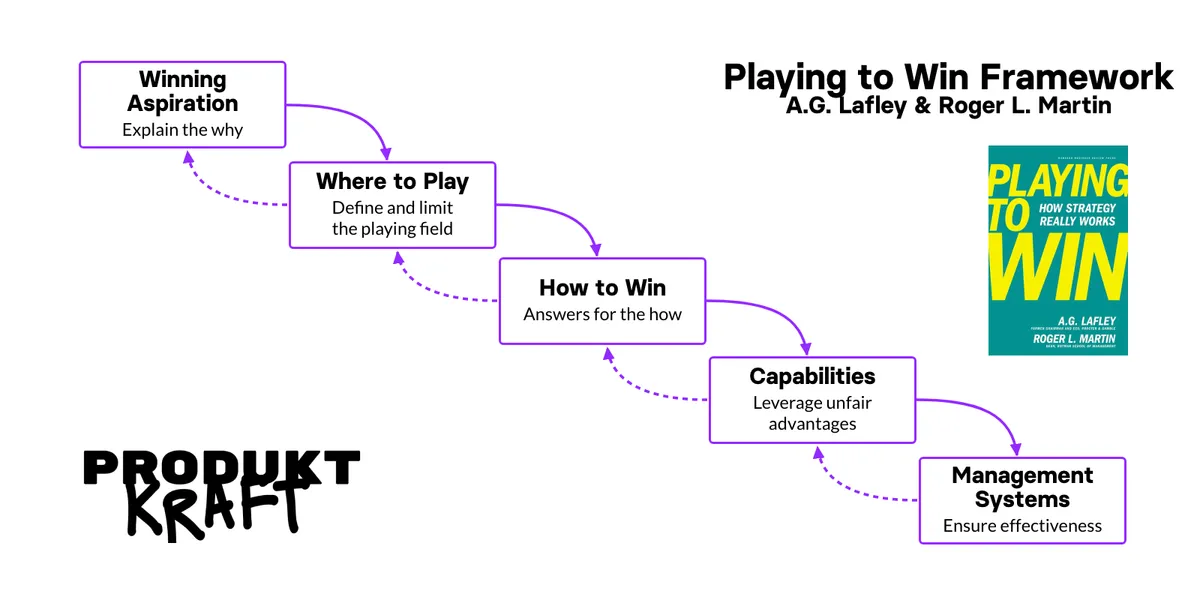
Winning Aspiration – Why Do We Work Here?
The first question asks what the company ultimately wants to achieve. This goal should describe a bright future that is valuable to customers and employees alike. So a strong answer sounds less like “reach a 70% market share” and more like “make life easier through innovation.”
Where to Play – Where Do We Play, and Where Don’t We?
Next, the framework demands a decision about where the company wants to operate. In concrete terms: in which geographic region? With which products or services? For which customer segments? Through which sales channels? How deep do you go into verticals or into the value chain?
How to Win – How Do We Win?
The third step demands an answer to the question of how the company wants to stand out in the market. There are two main strategies: either strong differentiation from the competition or the ability to offer a product or service more cheaply than the competition. With cost leadership, though, you should ask yourself whether you can really be the cheapest provider, because only one company can hold that position. If the answer to the “how” remains weak, you should reconsider whether you have chosen the right playing field and go back to the previous question.
Capabilities – Which Unfair Advantages Can We Use?
Now it gets specific: this is about analyzing the organization’s capabilities and systems in detail. The best levers emerge where your own company can do something others can’t – and then uses that capability across several areas. If you have the strongest brand, for example, you shouldn’t only use that advantage in marketing, but also factor it into product development.
Management Systems – How Do We Make It Work?
With the first four questions, you have achieved a lot and now know what to do. But to make sure it gets done, the organization has to be designed so that the plan is actually carried out. A one-off presentation at the start of the fiscal year isn’t enough. The strategy has to be built into everyday work. Routines and regular measurement, such as monthly check-ups to assess progress and possible adjustments, are essential.
What Else Should You Keep in Mind?
While the five questions bring clarity, answering them also means that certain opportunities are deliberately not pursued. It is important to understand the model as an iterative process and to revisit it regularly. This strengthens shared understanding and makes it possible to adapt to new conditions and insights.
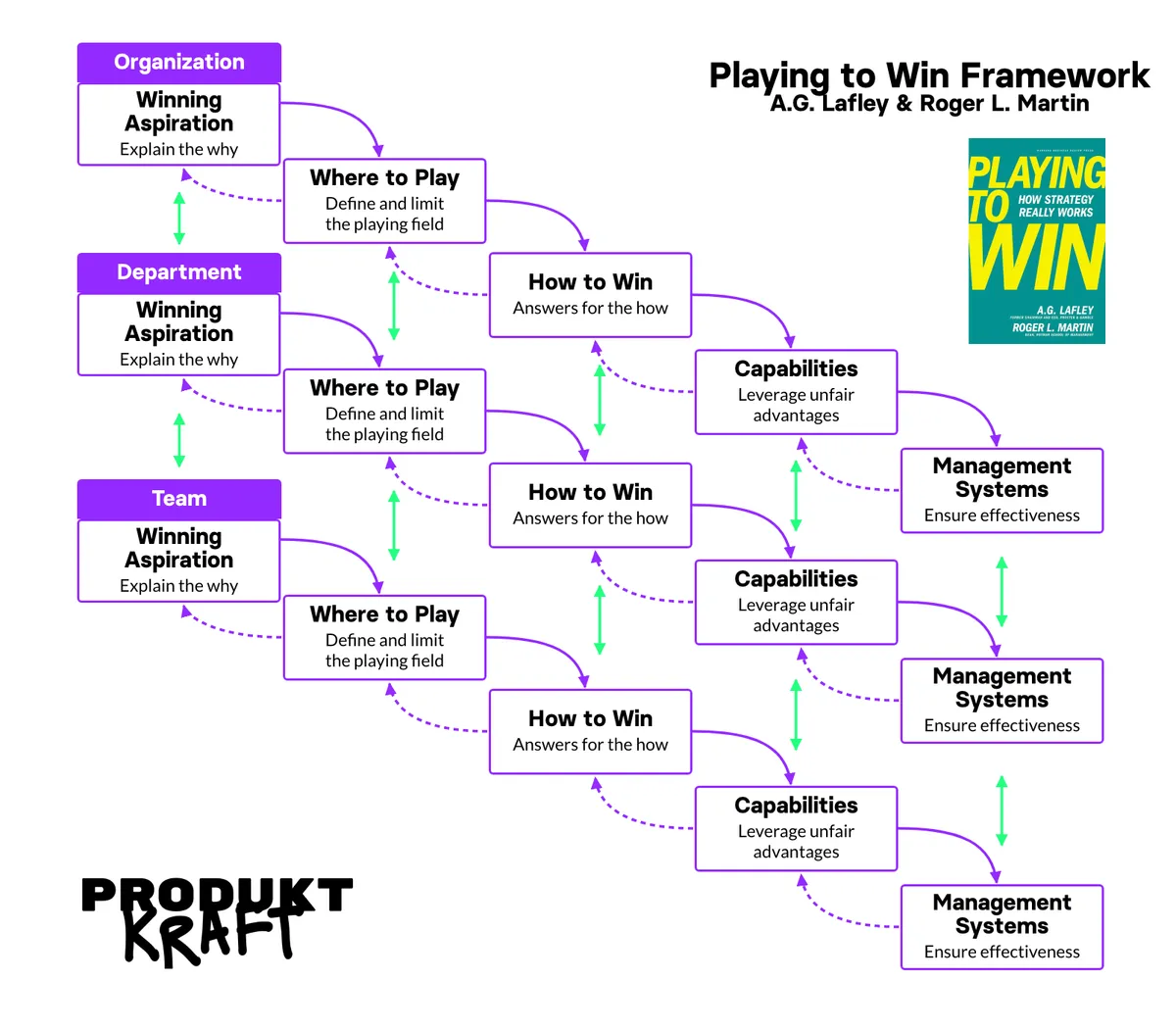
In large organizations, the model should be understood as a cascade that continues down to the lower levels of the company. You should start at the top level so that the lower levels know their room for maneuver.
Opinion: ‘Playing to Win’ – Rarely Helpful in Digital Product Work
Hot take: although the ‘Playing to Win’ framework sounds logical, it can do more harm than good in digital product development. In practice, it runs counter to two central goals of digital product development: speed and meaningful degrees of freedom for teams.
Implementing a strategy according to this model does create clarity, but it is laborious and slows decisions down. The ‘cascade of choices’, which you could just as well call a waterfall of decisions, brings with it exactly the criticisms we know from waterfall software development. Every problem that surfaces in the later stages of the cascade has to flow back up through it. That need not be a problem when working out a general company strategy once – after all, at most four decisions have to be revisited. But when we try to work through the framework across several organizational levels – company, departments, team – we quickly reach a level of complexity that stifles sensible adjustments simply because the communication feels like too much effort.
When it comes to teams’ degrees of freedom, one thought deserves particular emphasis: the line between a clear strategy in the sense of this model and a long feature roadmap is extremely thin. Leadership that has worked out in detail exactly how to beat the competition’s products is rarely the same leadership that places a high value on strong discovery work by empowered teams. In everyday work, a mindset of good planning all too easily grinds against the agile insight that this very predictability is, unfortunately, impossible.
So in digital product management, the framework should be taken with a grain of salt. Still, there are moments when working with Lafley and Martin’s model can pay off. This is especially true when you need a good overview – for example, because you are just starting to develop a product, or because you notice that important KPIs aren’t moving despite your efforts. Or in situations where fast adaptation to a dynamic market doesn’t matter much – for example, when a product reached product-market fit long ago and the goal now is only to extend its life cycle.
In most other cases, though, I encourage you to bring out the full strength of your product teams with a strong vision and clear goals. A certain degree of strategy should of course play a role, but in an informing rather than a directing form, as the framework describes it.
Read the Book, or Are Online Resources Enough?
Setting aside the limited recommendation for digital product development, the reading experience was a mixed one.
On the one hand, I was impressed by the depth, especially the guidance and tools for answering the five strategy questions. The book clarifies far more details and pitfalls than the more general online resources on the framework, and many smaller sub-frameworks make it much easier to apply. So if you are serious about the ‘Playing to Win’ model, there’s no way around reading it.
On the other hand, the constant use of cases from Procter & Gamble’s history as examples creates long stretches I would have happily skipped. It feels like half the book consists of shower gel and hand cream examples, in which developments spanning decades are reduced to a single paragraph that supports the theory all too neatly. That is presumably meant to ground the book, but it didn’t win me over: with my background in digital product development, the examples simply have little relevance.
So useful tools alternate with not-so-relevant examples from real life. I recommend the book to two groups: first, readers who have had initial success with the model based on online sources and want more depth; and second, readers who are fascinated by the history of Procter & Gamble or the consumer goods industry. Everyone else: start online, then decide how far you get. Your time is usually better invested in practical strategy work!
Looking for Support with Strategic Questions?
You build digital products and want to strengthen your strategic foundation? I’m Jan, and I’m happy to help. Just book a no-obligation intro call, and we’ll see whether and how I can help you.