November 23, 2024 · Jan Hoppe
The Creative Act: A Way of Being – Why Is Rick Rubin’s Book So Relevant for Product People?
Why does Rick Rubin’s ‘The Creative Act: A Way of Being’ keep coming up in the product management community? Should you read it as a product person? I’ll tell you!
Rick Rubin (2023): The Creative Act: A Way of Being. Canongate Books Ltd. €20.99
German edition: Rick Rubin (2023): kreativ. Die Kunst zu sein. O.W. Barth. €24.00
Prices as of November 2024
Every now and then, a book comes out that seems to have little to do with product management and yet has a great deal to do with it. The legendary music producer Rick Rubin, who has worked with Run-D.M.C., Public Enemy, the Beastie Boys, Eminem, Slayer, Metallica, Johnny Cash, the (Dixie) Chicks, Danzig, System of a Down, Rage Against the Machine, Weezer, the Strokes, Adele, Kesha, and Lady Gaga, among others, has written such a book. What makes it so special? Why, for example, does it get a passing mention in Lenny’s Newsletter in a piece on finding product-market fit in a B2B context, and why does Marty Cagan write a blog post about it being a special book? Buckle up, I’ll tell you.
What Is ‘The Creative Act’ About?
Broadly speaking, the book is about developing a mindset that fosters creativity. Before I try to describe this mindset in concrete terms, I want to get one thought out of the way: anyone who reviews this book and sums it up with a model or framework hasn’t understood it. Every other chapter stresses that it only offers food for thought and that everyone has to find their own way.
Nothing in this book is known to be true. […] Some ideas may resonate, others may not. […] Use what’s helpful. Let go of the rest.
– Rubin 2023
So that you still get an idea of what it’s about, I’ll attempt a summary of what I see as the book’s two big pillars. But do yourselves a favor and don’t treat them as a formula or a process – I’m only trying to create a basis for discussion.
Tuning In & Tuning Out
Running through the book is an image of human beings as fundamentally creative. Creativity here doesn’t only refer to artistic work, but quite fundamentally to our relationship with the world around us. Every perception that we become aware of, or that influences us unconsciously, inspires new thoughts. These then manifest in new actions, which in turn lead to new perceptions – and the cycle starts over. Sounds abstract and complicated, but it’s actually quite simple. A concrete example: if you spend a year traveling, it will sharpen your sensitivity to the peculiarities of your own culture. You start to notice things you would otherwise have been blind to, and you behave differently.
Tuning in describes the process of deliberately directing our attention toward the things that foster our creativity. Again, in concrete terms: if you want to develop a better intuition for decisions in digital product management, you can do so by analyzing successful apps and forming hypotheses about why they are successful. Over time, patterns and connections take shape that sharpen our eye for what is good. As a result, we have a better intuition for product management decisions.
Because there’s an endless amount of data available to us and we have a limited bandwidth to conserve, we might consider carefully curating the quality of what we allow in. […] Level up your taste.
– Rubin 2023
Tuning out – but Rubin isn’t only concerned with which influences we deliberately engage with, but also with which ones we deliberately block out. In concrete terms: someone who uses a lot of mediocre apps and platforms will find it hard to develop a strong picture of excellence.
Tuning in and tuning out don’t only apply to our surroundings, though, but also to our personality and our consciousness. Each of us, for example, internalized voices while growing up that still shape our thinking as adults. Whether it’s a particularly critical mother, an always-praising father, a teacher who believed in us at a critical moment, or a sports coach who was certain we would never amount to anything. The point is to become aware of these influences so that we can amplify or silence them at the right moment.
With this deliberate mindset as a foundation, we now turn to the creative process itself.
The Creative Process
To stress it once more: Rubin explicitly and emphatically says, again and again, that everyone has to create their own creative process and that he only wants to offer food for thought. With that disclaimer out of the way, I’ll briefly sketch the stages he describes.
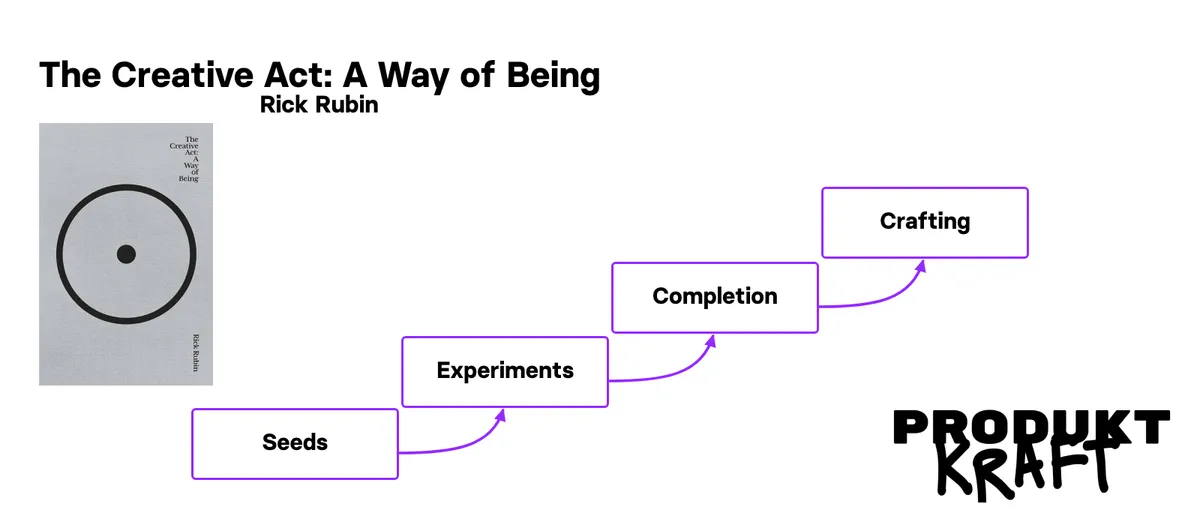
Seeds emerge in moments of inspiration that reach our perception day in, day out. An idea for a picture, a new association between two frameworks. Rough diamonds of ideas, in other words, many of which will never be realized but which carry the potential for it. The point is to collect them and become aware of them, so that we can develop the best ones.
Experimentation is needed to let the seeds grow. Does the idea only sound good in our heads, or does it also work in practice? We have to try it out. And what do we learn from it? Does an idea perhaps develop in a completely different direction? What matters here is to keep letting ourselves be guided anew and not to cling to a first notion.
The next step, crafting, is then about discarding ideas and narrowing the space of possibilities again. We build prototypes, paint pictures, write texts – holding different versions side by side to arrive at ever stronger results.
Finally, completion is about reflecting on everything learned in the crafting phase and rounding it off into a coherent result. This is also the moment when we release our work. Because this is also when it becomes clear whether the world meets the results of our creativity with indifference, criticism, or praise, it is the most emotional part of the work for many people.
Why Is The Creative Act Relevant in Product Management?
At first glance, there are many analogies to design thinking: developing ideas after gaining an open perspective, generating numerous approaches, experimenting with different possibilities – all of this sounds familiar. So does the book resonate so strongly because it seems intuitively logical to product people? I don’t think it’s that simple. If drawing analogies to familiar paradigms were enough to gain relevance, many other publications would be more successful. In my opinion, the truth lies deeper. Rubin strikes a nerve in our community with both his content and his writing style.
Any Framework, method, or label you impose on yourself is just as likely to be a limitation as an opening.
– Rubin 2023
As product people, we move in a world where countless answers are presented at conferences and in books: “This is how your strategy has to be designed to increase interactions tenfold!” – “With this framework, the entire organization is perfectly aligned!” – “With this one simple trick, the product trio works flawlessly!” – “With this method for self-organization and prioritization, feeling overwhelmed at work disappears!” – “With these arguments, you’ll convince the executive team to empower the teams!”
You surely know what I mean. In principle, I find it helpful to get approaches and solutions for the challenges of our everyday work. They open up new perspectives and show us that we are not alone with our problems. But all these answers – models, frameworks, canvases, processes, and words of wisdom – only ever work in specific contexts. In other situations, they are useless at best and a hindrance at worst, because they steer our thinking and our attention along fixed tracks – and thus limit our mental flexibility.
Anyone who has worked in product management for a few years knows the problem that the solutions of the scene’s thought leaders often don’t fit our individual contexts. So why does so little change on this front? The key to that question lies in the attention economy. Answers and clear, strong statements simply get more resonance – and I don’t exclude myself from that. How exciting does a talk titled “With this model, you can succeed in a few rare cases” really sound?
With his book, however, Rubin pulls off a stroke of genius: he offers inspiration, especially for product people, without insisting on concrete answers. He offers many answers, but emphasizes the individual search for answers. His work shows how we can use our creativity to find our way better in an environment that constantly demands creative solutions. And at every step, he encourages us to shape our own paths. That is not only a refreshing alternative to the dominant attention economy, but also more empowering than any transformation that brings empowerment to a team from the outside.
I’m a Product Manager – Should I Read The Creative Act: A Way of Being?
Yes! Product management is a discipline that demands creativity at every level. Whether in dealing with stakeholders, in working out new features, or in figuring out how to release an MVP sooner – creative thinking is our everyday craft. Rick Rubin has written a book that, in a world full of ready-made answers, doesn’t deliver concrete solutions but strengthens our ability to find our own. Especially in our increasingly complex role, that is an invaluable advantage. That Rubin, in his concise language, still offers plenty of food for thought and possible approaches gives the book the grounding it needs – and makes it essential reading for product people.