December 10, 2024 · Jan Hoppe
Model Explainer and Book Review: The Five Dysfunctions of a Team
Patrick Lencioni’s The Five Dysfunctions of a Team is now more than 20 years old. Are the book and the team development model it describes still relevant? I take up this question from a product management perspective.
Lencioni, Patrick (2002). The Five Dysfunctions of a Team: A Leadership Fable. Jossey-Bass. €30.81
German edition: Lencioni, Patrick (2014). Die 5 Dysfunktionen eines Teams. Wiley-VCH. €21.99
Prices as of December 2024
Successful product management stands or falls with how well the teams you work with function. That already applies to your own engineering team, but it carries even more weight when you consider that many of us work in several teams at once. As PMs, for example, we act within a hands-on development team and are at the same time part of a team with other product people. That’s why it’s essential to understand how teams function and how to counteract dysfunctions. In his book The Five Dysfunctions of a Team, Patrick Lencioni presents a model meant to help with exactly that, in the form of a business fable followed by a summary. What this model is all about and whether the book is worth reading for product managers – you’ll find out in the following paragraphs.
Simply Explained: The Five Dysfunctions of a Team Model
When does a team not function, and where do you start when collaboration stalls? The model describes five typical traps that occur in many teams.
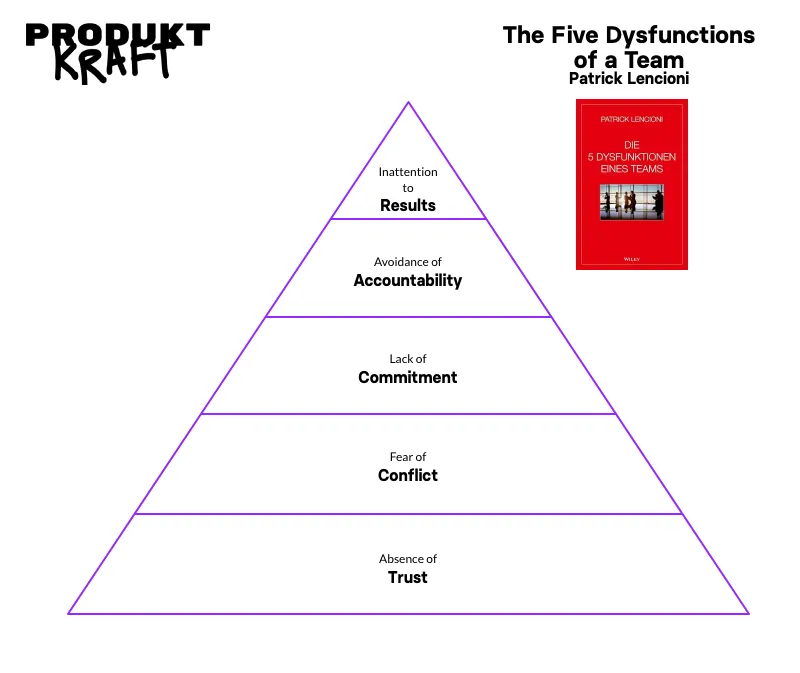
Dysfunction 1: Absence of Trust
Trust means assuming that all team members, including yourself, are doing the best possible work with good intentions. Trust also means there is no reason to communicate strategically or to protect yourself, because there is a good degree of psychological safety.
You can recognize a lack of trust when individual weaknesses are concealed, feedback is rarely sought, and team members shy away from stepping on each other’s toes. Teams with high trust, on the other hand, address problems openly and respectfully and have no need for political behavior.
Dysfunction 2: Fear of Conflict
There are many situations in which different interests collide. Should stronger UX design be prioritized even though it makes development more laborious? Is technical debt paid off right away or only next quarter? Do we build a feature that takes load off the marketing team, or do we create more value for end users?
Teams that fear conflict struggle to resolve such questions quickly and productively. Instead, they remain stuck in wait-and-see mode. Meetings often end with a topic being raised but a decision being postponed.
Dysfunction 3: Lack of Commitment
Commitment creates clarity and alignment. Strong teams know that full consensus is rarely reached. It is normal to support decisions you would personally have made differently. These teams recognize that decisively executing a possibly suboptimal decision is often better than making no decision at all.
Without commitment, decisions are constantly reopened, which leads to an atmosphere of ambiguity, which in turn slows action down. Committed teams, on the other hand, pursue their goals decisively and adapt without hesitation when goals do change.
Dysfunction 4: Avoidance of Accountability
The best teams set high standards and hold all members accountable for meeting them. Poor performance by individuals isn’t ignored, but addressed respectfully and sanctioned.
Without this accountability, it shows up as lasting resentment about individuals’ poor performance without it being addressed effectively. This leads to mediocre results. Strong teams, by contrast, hold each other accountable and push each other to peak performance.
Dysfunction 5: Inattention to Results
Strong teams always keep their shared goals in focus. They put the organization’s goals above individual needs and don’t look for tactical advantages for themselves.
How can you tell the level of attention to results? Dysfunctional teams stagnate in their performance, which frustrates committed members. Strong teams recognize that long-term team success does more for everyone than individual advantages.
Developing Teams: From the Base to the Top of the Pyramid
The image of a pyramid, as drawn in the book, is no coincidence: it makes clear that the lower levels create the foundation for the upper ones. If there is a lack of trust, for example, team members tend to gloss over their work results, so that accountability or results can’t even be discussed. If you apply the model to your team and see room for improvement at several points at once, you should therefore work your way through in order, from dysfunction 1 to dysfunction 5.
Opinion: Useful and Scientifically Grounded – or Just Nice-Sounding Words?
In more than a decade of product work, the five dysfunctions model has served me again and again as a valuable compass when things weren’t working in a team. I couldn’t always solve every problem, but it helped me enormously to recognize why things weren’t working. No wonder! Because even though the book doesn’t mention it explicitly, the dysfunctions and their functional solutions rest on a broad scientific consensus.
For example, Google’s Project Aristotle showed that psychological safety is the most important factor in team performance – a clear parallel to dysfunction 1, the absence of trust. Fear of conflict, in turn, can be found in the concept of groupthink by social psychologist Irving Janis. Lack of commitment reflects aspects of Edwin Locke and Gary Latham’s goal-setting theory, while avoidance of accountability correlates with the concept of social loafing, which Max Ringelmann researched as early as 100 years ago. The strength of pursuing shared goals in dysfunction 5 is also reflected in the concept of collective efficacy, which was studied by Albert Bandura, among others.
What I find particularly remarkable is that, despite being more than 20 years old, the model is still highly relevant. Thanks to its scientific grounding, it is a generalizable and timeless model that can still be used with a clear conscience today.
Who Should Read the Whole Book?
As here, the book is often discussed in articles that only summarize the five dysfunctions. In the book itself, however, the model is presented in the form of a “leadership fable” – a fictional story describing the transformation of the management team at DecisionTech Inc. The story is entertaining, but in its didacticism it doesn’t quite escape a certain cringe factor. Since the model is only covered in depth on the last 30 pages, I really only recommend the book if you can stand the genre of business fiction.
Conclusion: ‘The Five Dysfunctions of a Team’ – Still Relevant!
Whether as a product manager or in any other role: whenever a team is in crisis, it’s worth taking a look at The Five Dysfunctions of a Team. With its scientific grounding and having stood the test of time, the model directs the focus to aspects that can strengthen teams. Especially if you act as a team lead or have one at your side, the model gives you a good chance of improving the situation.