
January 22, 2025 · Jan Hoppe
The Cold Start Problem by Andrew Chen: Model Explainer and Book Review
What is Andrew Chen’s ‘Cold Start Theory’? I explain the model in simple terms and look at whether the book that goes with it, “The Cold Start Problem: How to Start and Scale Network Effects,” is worth your time.
Chen, Andrew (2021). The Cold Start Problem: How to Start and Scale Network Effects. Penguin Random House UK. €9.99
Prices as of January 2025
Network effects are the golden key for any application that connects different participants with each other. They are considered the growth engine of the tech giants and the dream of many startups. Yet despite their importance, it is often hard to name network effects clearly or to foster them deliberately. Everyone wants them, but few know how they actually work. A gap waiting to be filled.
In his book “The Cold Start Problem: How to Start and Scale Network Effects,” Andrew Chen takes on this challenge. He develops a model that systematically describes growth through network effects, explains the basic concepts, and illustrates his theory with vivid examples. Whether his approach is convincing, how his model works, and whether you should read the book – I’ll go through that below.
The ‘Cold Start Theory’ Framework Simply Explained
Let’s start with the basics. Traditionally, the value of a network is often described by Metcalfe’s law: value grows with the square of the number of participants. Chen shows, however, that this approach falls short. Using the example of meerkats, he illustrates that more isn’t always better. Building on these parallels to biology, he presents the more nuanced model of Cold Start Theory.
The basic idea: network effects can be divided into different growth phases, each bringing its own opportunities and challenges. Note: the model is mainly suited to products whose value increases with a large number of connected users. Products that are used alone can’t be analyzed well with the framework.
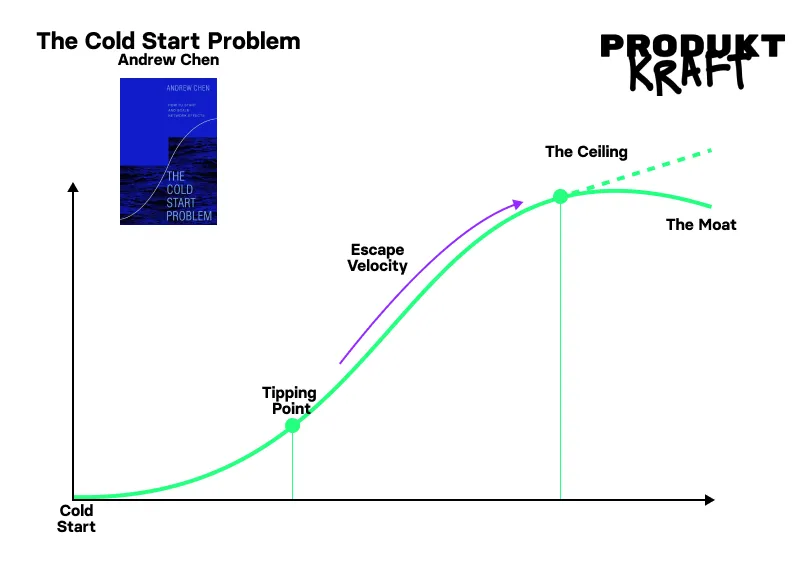
Cold Start
Network-based products face their biggest challenge at launch: without users, the network’s value is low or even negative. A social network without active members feels empty, a marketplace without listings is useless, and a messaging app without users might as well be deleted right away.
To avoid these anti-network effects, Chen recommends first concentrating on the smallest possible network, the so-called atomic network. This means that instead of building the big network from the start, it is more effective to create a smaller network that is easy to reach. Like the choke on an engine, this strategy reduces the effort and the risk of establishing a meaningful network.
Examples? Facebook once launched exclusively for Harvard students. Amazon started with books, eBay with collectors. Communication apps like Zoom can make two people happy at first – that’s enough to plant a seed.
Tipping Point
Once the first network is established, you reach a tipping point: expanding into adjacent networks becomes easier and less risky. Facebook, initially open only to Harvard students, benefited from existing connections between users when it rolled out to other Ivy League colleges. A product like Zoom, in turn, can easily expand from its first two or three users to entire teams and organizations.
Escape Velocity
In this phase of the framework, Chen describes the moment when a network grows exponentially, seemingly all by itself. At first glance, it may look as if the work is now getting easier – but the opposite is true. Behind the rapid growth there is often enormous effort to keep the momentum going. In this phase, companies often have to hire hundreds or even thousands of new employees, raise additional funding, and massively scale their infrastructure. All of this happens under high pressure, so that the network doesn’t collapse under its own weight and can keep expanding.
Chen stresses that in this phase, it isn’t enough to simply talk about “network effects.” Instead, you should look at three specific effects that drive growth:
The acquisition effect: New users become ever easier and cheaper to acquire.
The engagement effect: The growing number of interactions makes the network more attractive for all participants.
The economic effect: As the network grows, monetization also becomes more effective.
These three effects reinforce each other and thus lay the foundation for the explosive growth that characterizes this phase.
Ceiling
At some point, growth hits a ceiling. Declining engagement, rising acquisition costs, spam, poor UX, or overloaded technical infrastructure can be symptoms of this. In practice, a network often runs into several such ceilings. Successful products overcome these hurdles through continuous adaptation and improvement, and in doing so make sure that the actual ceiling keeps getting raised for as long as possible.
Moat
In the last step, the point is to look at how you can use your own network deliberately to protect yourself against competitors. After all, nothing stops a competitor from copying the product and offering it at competitive prices. Accordingly, you have to think individually here about how the entire ecosystem can be used to create an overall package that no competitor can copy.
There is no universally valid answer for a successful moat, since every network and every product is highly individual. To make it tangible anyway: Amazon uses the enormous size and reach of its own network to develop a tailor-made logistics solution that spans everything from purchasing through warehousing to delivery – and outpaces conventional parcel services in terms of speed. This unique efficiency can only be achieved through the scale of the network and is practically impossible for new market entrants to replicate. At the same time, it binds customers to the platform for the long term and makes the marketplace indispensable for countless small merchants, which in turn strengthens the network further from within.
Applying the Model
When you apply the model to your own product, its particular value lies in directing the focus to what matters and blocking out unnecessary aspects. A startup that hasn’t gained traction yet should concentrate exclusively on the cold start – all other considerations are secondary at that point. An app that has a small, happy community but isn’t growing organically yet should focus primarily on reaching the tipping point. Once that point has been passed and the product is growing strongly, the question moves to the foreground of how this growth can be deliberately supported and stabilized.
If growth stalls, a detailed analysis of the obstacles is needed in order to remove them in a targeted way. And if the network comes under attack from the outside, for example from new competitors, you have to concentrate on deliberately playing out your own unfair advantages – such as features that can’t be copied or market conditions.

How Useful Is the Model in Practice?
The model’s biggest advantage is without question its focus. I have often seen discussions about network growth drift from one tangent to the next because it was unclear which aspects to concentrate on given the network’s growth phase. Questions of technical scalability quickly get mixed up with considerations about organic growth opportunities or a look at the competition. In these situations, the framework helps enormously to keep what matters in view.
Another plus is the solid evidence, thanks to many small case studies. This isn’t pure theory or superficial work, but a framework that stands on a solid basis. All in all, the model is a valuable contribution to the product development toolkit.
One weakness of the book, however, is that it sheds too little light on the model’s limits. It does show vividly, using many success stories – such as Uber, Facebook, Airbnb, Tinder, Wikipedia, or Zoom – why the framework works. But the focus is clearly on the success cases, where many factors other than building the network also played an important role. Failures like Google+ are mentioned, but take up much less space. This creates the impression that the success stories are in the spotlight primarily because they confirm the model.
This becomes especially clear with the example of Clubhouse, which was celebrated as a prime example of a successful cold start when the book came out, but is now only a fringe phenomenon. The model does explain the initial hype, but offers no answer as to why Clubhouse faded into insignificance so quickly. External factors played a decisive role here, such as the end of the lockdowns and the resulting decline in interest in the core value proposition – aspects that the book largely leaves out. So see the framework as a useful addition to your toolkit, but don’t forget to take into account the context of your product and the specific circumstances of your situation.
Is Andrew Chen’s “The Cold Start Problem” Worth Reading in Full?
As a Western European reader, I find it hard to look past the author’s writing style. On the one hand, I wonder why I’m reading entire pages about Chen having drinks with Tinder co-founder Sean Rad at the Chateau Marmont, or why I had to learn that he has a personal connection to Reid Hoffman, who has a soft spot for the same group of islands the author grew up on. These not-so-humble brags left me less impressed and more rolling my eyes.
On the other hand, a slightly irritating bro vibe runs through the writing, peaking on the last pages, where Chen speculates that crypto and the blockchain will soon revolutionize every aspect of software development – as so often with such arguments, without explaining why that would make sense.
Given the strength of the framework and the density of vivid case studies, I can personally look past these moments and recommend the book to anyone working on products with network effects.
Conclusion
With his ‘Cold Start Theory,’ Andrew Chen delivers a solid tool for shedding light on the different phases of growing or stagnating networks. It creates excellent focus that can help teams steer discussions toward the essential points. Caution is advised, however, against applying the framework blindly, because it rests on a certain survivorship and confirmation bias. Not every situation matches the ideal type, and aspects of a changing environment in particular get somewhat short shrift. If you factor that in, though, you can read the book with profit and apply the model well.
Need Hands-On Support?
I don’t just summarize frameworks or review books. I have also been doing hands-on product work for more than a decade, and I help teams and companies strengthen their product work on a freelance basis. Feel free to book a no-obligation intro call or send me an email at jan@produktkraft.com, and we’ll see whether working together makes sense.