
February 26, 2025 · Jan Hoppe
Book Review: The Best of Lenny’s Newsletter Volume 1
With “The Best of Lenny’s Newsletter Volume 1,” Lenny Rachitsky has published a collection of the strongest posts from his newsletter. Essential or not? I’ll tell you!
Rachitsky, Lenny, ed. (2024). The Best of Lenny’s Newsletter Volume 1: Insights, frameworks and practical advice from the world’s top product experts. €28.21
Prices as of February 2025
I’m probably not alone in thinking that Lenny Rachitsky’s work has an enormously positive influence on how knowledge about digital product management spreads. His two big channels, Lenny’s Newsletter and Lenny’s Podcast, have become important sources for the craft of digital product management in recent years.
As a bookworm and a fan of Lenny’s work, I naturally couldn’t resist when the collection of the best articles from Lenny’s Newsletter came out last year. Without further ado, I ordered the book, which has since sold out. Whether it’s worth reading in general, and whether you should be annoyed if you didn’t manage to get a copy, is what I want to lay out for you here.
The Good
The obvious and subjective point first: if you like the feel of paper in your hands and, even as a digital worker, prefer reading on paper to reading on screens, it’s simply pleasant to have the tactile experience of a book. All of the book’s content can also be found online, but I’m one of those people who can simply focus more deeply in analog form, so I like the format to begin with.
In terms of content, too, the 19 articles contain genuinely valuable highlights that, in my view, every product person should have read. Here are links to my personal top three.
How Duolingo Reignited User Growth
Have you ever wondered how Duolingo’s streak feature became the powerful retention booster we know today, one that has found its way into what feels like every other app? (I have four active streaks going – can anyone beat that?) The most-read article in Lenny’s Newsletter explains the genesis of this brilliant feature, including its difficult birth and the strong BI behind it. An absolute must-read!
Link: How Duolingo reignited user growth by Jorge Mazal
A Quickstart Guide to Positioning
On the surface, positioning digital products is simple. You define the area in which a product should lead and for which clearly defined group of buyers that matters. The article describes why simple vision statements (“For [final client], whose [problem that needs to be solved], the [name of the product] is a [product category] that [key-benefits, reason to buy it]. Different from [competition alternative], our product [key-difference].”) can be harmful. Instead, April Dunford briefly lays out her alternative model, which works with a clear focus on users.
Link: A Quickstart Guide to Positioning by April Dunford
How to Develop Product Sense
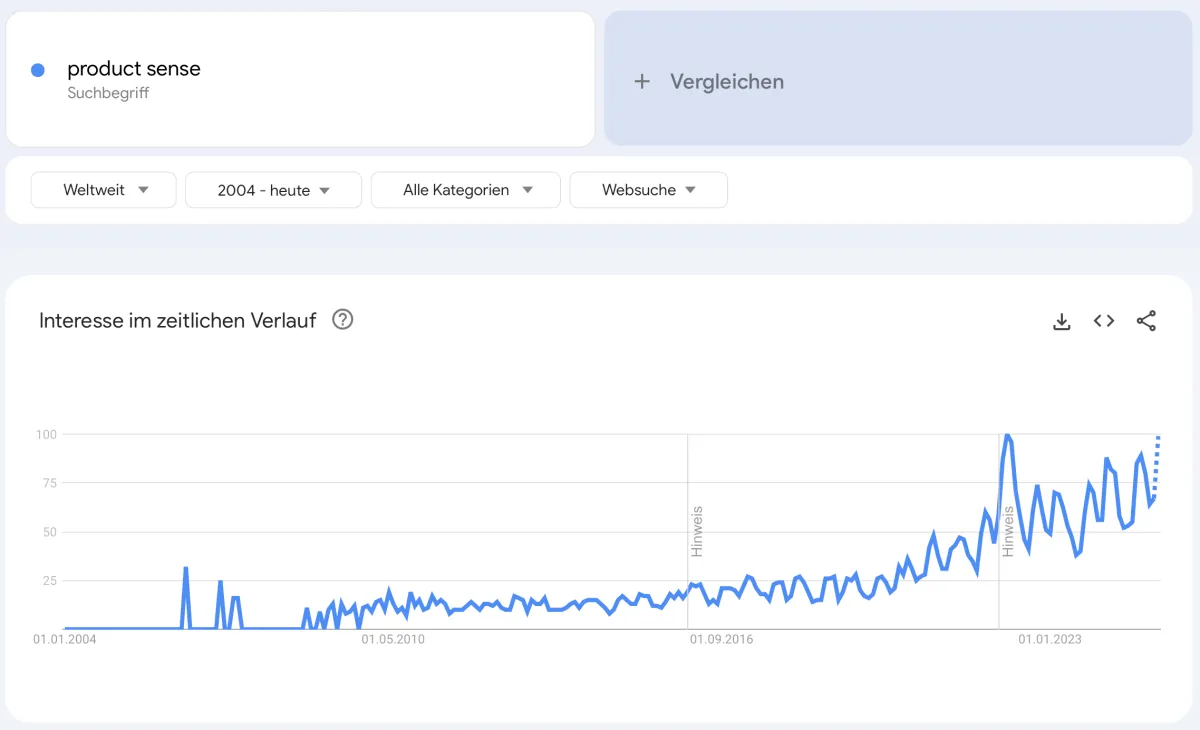
Product sense is a term that, if we can believe Google Trends, has been gaining relevance since around 2020. (Fun fact: the peak in the curve above is the release of the article discussed here.) This strong post first defines product sense as the ability to consistently build or change products in a way that has a targeted effect on user behavior. Empathy and creativity are named as the foundation of this ability, and Jules Walter uses simple examples to introduce strong techniques for developing your own product sense.
Link: How to develop product sense by Jules Walter
The Bad
Unfortunately, where there is light, there is also shadow. Let’s start with the criticism on the content side: the book does offer absolutely outstanding articles, like the ones described and linked above. Unfortunately, it also contains posts that simply collect answers from product leaders to certain questions. Without deeper context, these collections feel somewhat arbitrary.
One article that illustrates well what I mean is about how to find your first 10 B2B customers. In it, we hear dozens of personal anecdotes: that the first users of Notion or Figma were friends with the team, that the Personio team really had to hustle for its first paying customers, or that at Vanta, investors were sometimes asked which potential customers they had in their portfolio. That’s nice enough to read, but unfortunately I see absolutely no value for my day-to-day work in these commonplace quotes.
Link: How to find and win your first 10 B2B customers by Lenny Rachitsky
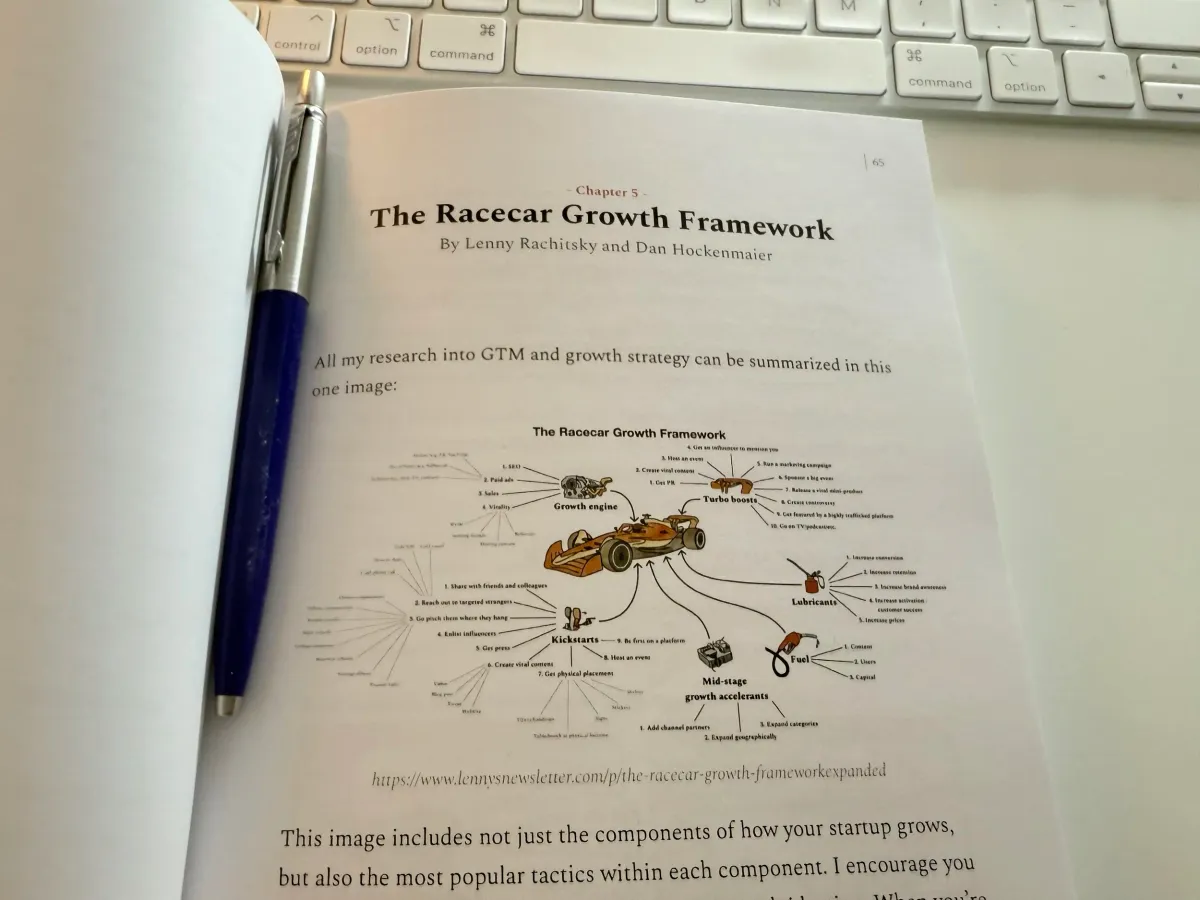
Besides the (few) weaker pieces, it also has to be said that the design and layout of the book come across as somewhat careless in places. Apparently, the web content was printed in the book without any special adaptation. The problem: content you can zoom into on the web can’t even be made out in print. The small labels on the racecar, for example, are only 1 mm tall (ballpoint pen for reference). I don’t want to be petty, but a little more love in the design would have done the book good.
The Verdict
The content of Lenny’s Newsletter is of tremendous value for product work almost throughout, and the book does indeed bring together a strong collection. If you like having something to hold, the first volume of The Best of Lenny’s Newsletter is a nice addition to your professional library.
Especially given that the design wasn’t adapted to the print format, though, I can reassure everyone who didn’t manage to get a copy: you haven’t missed anything. So before you go looking for a copy, listen to Lenny’s Podcast or read Lenny’s blog instead.