March 25, 2025 · Jan Hoppe
Impact-First Product Teams by Matt LeMay: Summary and Review
Impact-first product teams are teams for whom working on outcomes instead of outputs doesn’t go far enough. Instead, they put the whole business in focus. How can that work, and is Matt LeMay’s book worth reading? You’ll find out in this article.
LeMay, Matt (2025). Impact-First Product Teams: Define Success. Do Work That Matters. Be Indispensable. €21.30
Prices as of March 2025
There is no getting around it: the last two and a half years have been challenging for the digital economy in Germany. Since the end of the low-interest-rate era, fundraising has become harder, and countless companies have had to put far more focus on profitability. We have all watched the consequences of this rapid shift: large corporations and big Mittelstand companies – Germany’s mid-sized, often family-owned businesses – have taken a beating, while smaller startups are glad to still exist at all.
While this economic situation is tragic for individuals, it also brings an uncomfortable truth to light: in many organizations, reducing headcount did not necessarily lead to a drop in revenue. So what is going on? Why can so many companies reduce the number of product teams without any noticeable effect on the bottom line? And if there is no direct connection between the work of many teams and the bottom line – what does that say about the value of our work?
Matt LeMay’s new book, Impact-First Product Teams: Define Success. Do Work That Matters. Be Indispensable., tackles exactly these questions – and strikes a nerve! But let’s start at the beginning: what does LeMay mean by an impact-first product team?
What Is an Impact-First Product Team?
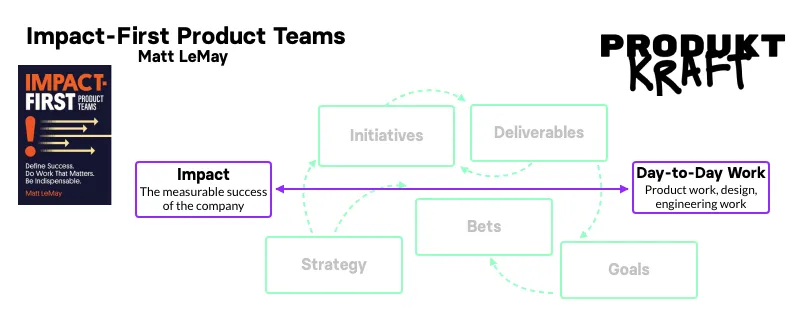
An impact-first product team gives clear priority, in every aspect of how it works, to its effect on the company’s success. Under the heading “The Business Is Your Business,” the author introduces his approach, which deeply integrates the responsibility of product teams into the company as a whole. The focus is on the direct connection between the business and our day-to-day work – not on the details in between. Teams achieve this by first asking what the company wants to achieve next, and then optimizing every aspect of their work toward it.
The book describes three concrete mindsets of an impact-first product team:
Focus on real impact: High-impact product teams set goals that have the potential to create a measurable, positive effect on the business – even when those goals are hard to reach or depend heavily on other teams. They deliberately look for the biggest levers instead of concentrating on comfortable, clearly bounded tasks.
Impact is a team responsibility: In an impact-first product team, responsibility for business impact does not rest with product managers alone. Engineers, designers, and everyone else involved also have to optimize their work toward the company’s goal and hold the team accountable.
Processes are a means to an end: Impact-first product teams don’t get lost in processes, frameworks, and methods. They use them deliberately as tools for business impact – not as ends in themselves.
In places, this way of thinking may seem unorthodox. Isn’t it explicitly the job of product managers to keep an eye on business value? Shouldn’t team goals be clearly bounded so teams can work autonomously? Here, we read the opposite of what is usually written. So how can this work?
How Do Impact-First Product Teams Work?
LeMay describes five core principles that make the practical work of impact-first product teams special:
1 - Putting Impact First
What are the measurable conditions that must be met for our business to be successful at a specific point in the future?
– Matt LeMay, Impact-First Product Teams
While traditional teams are measured by their output (that is, by which features they have built), modern, outcome-focused teams concentrate on changing specific behavioral KPIs of their users. Impact-first teams go further: they question not only how user behavior can be influenced, but whether that behavior actually has a measurable financial effect on the business.
2 - Impact-Driven Goal Setting
What measurable contributions will this team make to be considered a successful part of the business at a specific point in the future?
– Matt LeMay, Impact-First Product Teams
Another striking difference from common practice in many companies lies in how goals are set. LeMay argues that team goals should never be more than one level removed from company goals. This contrasts with the frequently used cascading of OKRs, in which teams drift away from the actual company goals over many intermediate steps. An example: faster registration leads to more users on the platform → more time in the app → more frequent views of the paywall → more frequent purchases. The problem: the further the team goal is from business impact, the more the focus blurs.
3 - Aligning Processes with Impact
Who needs to do what for us to achieve our impact-level goals – and why would they do it?
– Matt LeMay, Impact-First Product Teams
Many teams get lost in routines, workshops, and methods that simply continue out of habit, without anyone involved still knowing why they were introduced in the first place. Impact-first product teams understand that all these established, well-documented best practices matter – but only when they are used deliberately for business impact, not out of sheer habit or as cargo cult.
4 - Estimating Impact Realistically
What is the most impact we could reasonably expect from a given piece of work?
– Matt LeMay, Impact-First Product Teams
Impact-first product teams know they cannot predict the future exactly. But they use pragmatic methods and targeted assumptions to at least rule out low-potential ideas early and make better-informed decisions. They don’t shy away from back-of-the-napkin business cases; they embrace the quick calculation as a guide for their work.
5 - Continuously Adjusting to Actual Impact
What specific shorter-term signals should we see if we are on track to achieving our impact-level goals?
– Matt LeMay, Impact-First Product Teams
Impact-first product teams are masters at adjusting their planning iteratively. When a product bet doesn’t pay off, they correct course early instead of drawing a sobering conclusion at the end of the quarter. They set meaningful interim goals, measure progress continuously, and adapt their planning flexibly.
How Impact-First Product Teams Work, Summarized
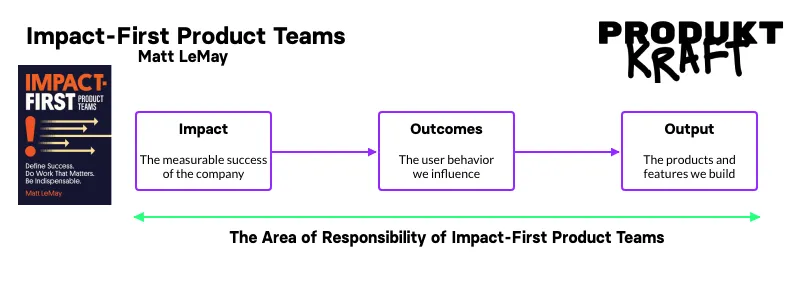
From the outside, impact-first product teams don’t look drastically different from other teams. They often use the same routines, tools, and processes. The difference lies in their mindset: they align their entire way of working uncompromisingly with business impact and work backward from there. This seemingly small difference makes a big difference in practice, because every detail follows a common thread that starts with the company’s success.
Conclusion: An Important Book at the Right Time – Highly Recommended!
I believe every product person should engage with Impact-First Product Teams! Why do I think this book is so relevant? Because lately I keep running into the same discussion: at meetups and in conversations with other product managers, I hear sentences like: “We used to be able to be there for the user, but now everyone only talks about money. When can we finally get back to doing good, user-centered work?” (translated from German)
This question reveals a misunderstanding that has crept in over the years: the idea that we don’t work for a business, but for the users. The flip side of that coin? If our work isn’t essential to the business, then we as product managers and product teams aren’t essential either. But strong product management is always both: user-centered and focused on business impact.
At a time when the digital economy is under massive pressure, it is more important than ever to sharpen our awareness that we build solutions for users that move the business forward at the same time. With many examples and guiding questions, Impact-First Product Teams shows in a practical way how we as product managers can create stronger value directly and make our work more effective. An absolute must-read for anyone who wants to see themselves not just as a feature supplier and user advocate, but as a strategic driver for the organization as a whole.