May 3, 2025 · Jan Hoppe
The Lean Startup by Eric Ries – Putting On a Classic!
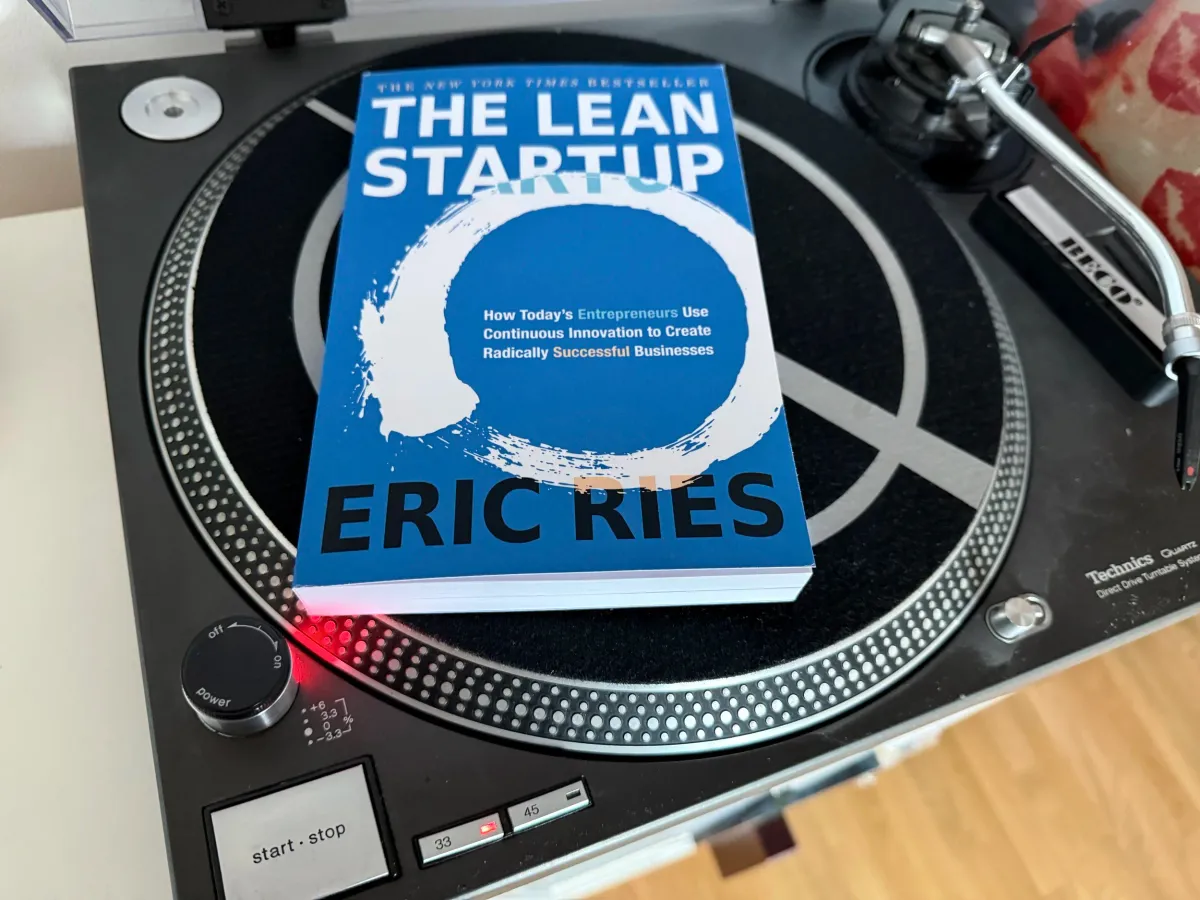
Eric Ries’s ‘The Lean Startup’ is considered the foundational work of product management because it addresses not just individual methods but the big picture: how teams with limited resources systematically drive innovation through fast, experimental learning and the build-measure-learn loop. This timeless methodology makes the book indispensable for anyone developing new products.
Ries, Eric (2011). The Lean Startup: How Today’s Entrepreneurs Use Continuous Innovation to Create Radically Successful Businesses. Penguin Random House LLC. €16.99.
German edition: Ries, Eric (2024). Lean Startup. Schnell, risikolos und erfolgreich Unternehmen gründen. Redline Verlag. €19.99.
Prices as of May 2025
When people ask me which is the best book on product management, in my view it is without question Eric Ries’s ‘The Lean Startup.’ First published in 2011, it explains with razor-sharp clarity, from a high yet tangible altitude, what matters in innovative product work. I’ll go out on a limb here: all the other relevant books on hands-on product work – including Marty Cagan’s ‘Inspired,’ Jeff Gothelf and Josh Seiden’s ‘Lean UX,’ John Doerr’s ‘Measure What Matters,’ and Teresa Torres’s ‘Continuous Discovery Habits’ – each shed light on individual aspects of the craft. The Lean Startup, however, focuses on the big picture and thereby provides much-needed orientation in the jungle of methods.
In line with this conviction that Eric Ries describes the foundation better than anyone else, I use the paradigm often and practically in my work, whether as an advisor, in hands-on product work for clients (many of whom are not startups), or in my own bootstrapping.
But I don’t want to just praise it without explaining why. So why do I consider the book so fundamentally important, and what is it really about at its core?
‘The Lean Startup’ – What Matters, Simply Laid Out
The basic idea is quite simple: whenever innovative things are built, whether in a startup or a large corporation, there is a certain maximum of resources that can be put toward getting the idea off the ground. This amount, also called the runway, can be large or not so large. It can mean that two people have to put something valid out into the world within three months, or that you can have 100 people work on a topic for two years. In every case, though, the means you have are limited. The goal of every new product is to have developed enough of the right thing within this limited time for the service to sustain itself, and to reach this goal, it is essential to learn as much as possible about which aspects work in the market and which don’t.
For the startup phase of a product (not of a company), what is central in ‘The Lean Startup’ paradigm is therefore not whether profits are being made, but whether the product has gotten better – in other words, whether it has moved closer to product-market fit. Successful innovations find this point and generate their revenue afterward, while unsuccessful innovations have the tap turned off before they can sustain themselves.
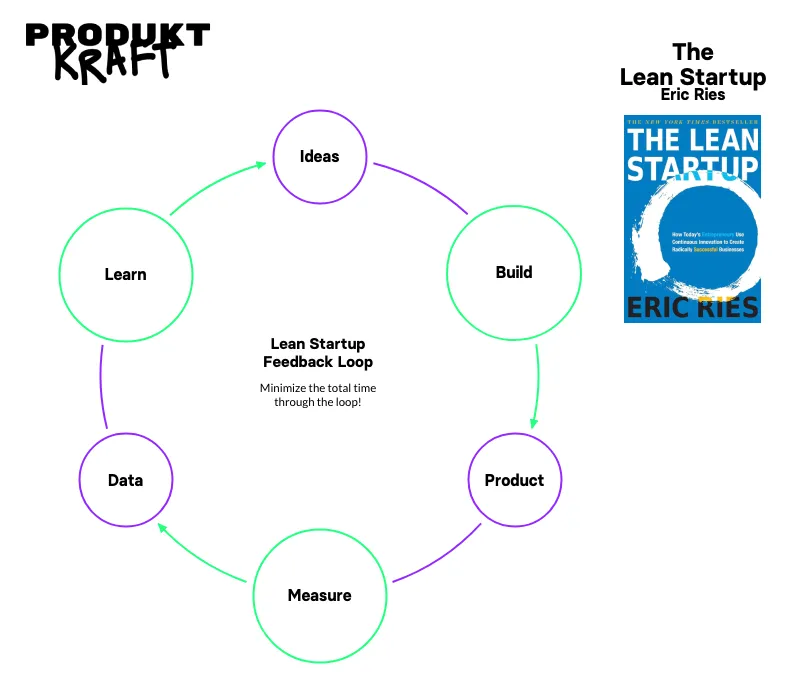
To put exactly this learning front and center, Ries draws the picture of a ‘build-measure-learn’ loop, which should be run through as quickly, and therefore as often, as resources, creativity, and skills allow.
The Lean Startup Model – The Feedback Loop Explained in Simple Terms
Step 1 – Ideas That Want to Become MVPs
Let’s start the description with what comes easiest to most of us and where the journey of innovation does in fact often begin: having ideas. In the Lean Startup model, the thinking is that you don’t put all your eggs in one basket and start by building a finished product. On the contrary, the point is to analyze which important hypotheses lie behind the idea and to work out what small experiments could look like that validate or falsify these hypotheses. These experiments are then built, and the results inform whether there is any potential at all and, if so, what the service looks like in detail. So what you need is a minimum viable product – the smallest possible product from which we can learn whether our assumptions are right.
A fictional example: let’s say someone has the idea of creating a super-fast delivery service for clothing – a Gorillas for clothes, so to speak (Gorillas being the Berlin startup that delivered groceries within minutes), to fill a niche between Otto, Zalando, and AboutYou, Germany’s big online fashion retailers, for those who spontaneously need an outfit for the evening but don’t want to go shopping. What would have to be true for this to work? One suggestion for the demand side of this idea: there has to be a relevant need for clothing delivered within minutes in the first place. What could that look like in our example if we want to act as quickly as possible? A quick implementation would be to run ads on social media platforms that lead to a website where you can enter your address, but always get the answer “Unfortunately, the service is not yet available in your area.” If our hypothesis about demand for super-fast clothing delivery is right, the ads should get clicked. So we’ve found an MVP that we can build alone in a day and that can still teach us whether we are on the right track.
By the way: Eric Ries didn’t invent the term MVP – that honor goes to Frank Robinson – but he did popularize it.
Step 2 – Measuring Relevant Data
In the second step, we look at what data our MVP generates and analyze it as robustly as possible, with the goal of generating new insights later.
Let’s go back to our example of the demand side of the super-fast clothing delivery service. So we have run ads on social media that lead to a landing page where you can type in your address. But we haven’t built a real delivery service yet, since for now we only want to check whether there really is demand for our service.
This MVP will generate a lot of data for us: for example, the conversion rates of our ads show us how much demand there is for our offer. Along the way, though, we also learn how expensive performance marketing is in the relevant segment, which affects other aspects of the business. And since we ask the people who click through to our homepage to enter their address, we also learn where demand is particularly high, if it exists at all – in the suburbs? In the city center?
So by using our MVP, we have more information available than at the point when we only had an idea.
Step 3 – Learning from Data to Generate New Ideas
We can now use the data our MVP collects to generate new, better ideas again and to gain more reliable facts that inform how our initial idea has to change to really be accepted by the market. This is important, because as much as most of us love to fall in love with our own ideas: unfortunately, reality often looks like this – the world hasn’t been waiting for us. There is no other way to explain why, depending on the data source, 80% to 95% of all startups fail within the first three years after founding, and why we see similar rates for the launch of new features for existing products.
So how do we reduce this risk using the Lean Startup methodology, discussed with our example? We look at what the collected data teaches us. Let’s assume we see that nobody clicks in Hamburg and Berlin, but Herford and Bielefeld, two smaller cities in western Germany, look promising? What could that mean? Looked at openly and honestly, it could raise several new hypotheses: is our service only relevant in smaller cities because there is less retail there? If so – is the value proposition of delivery speed really central, or have we merely discovered a niche where the big mail-order companies don’t advertise well? Or did our ad miss the fashion style of the big cities, and if so, what does that mean for our inventory? Many new questions come up, which then automatically generate new, better-validated ideas, and the loop starts over again with step 1.
Conclusion – Why Is Lean Startup the First Principle of Digital Product Management?
Introducing new digital services always comes down to two big factors: on the one hand, we want to avoid and manage risks. Put concretely, and with Marty Cagan’s focus, we want to make sure that our products have value (value risk), are understood (usability risk), can be built (feasibility risk), and work for the business (viability risk). At the same time, though, we also want to make sure we don’t play too defensively and think only about risks, because innovation needs ideation – needs new thoughts to be ‘thrown at the wall.’
Why Is ‘The Lean Startup’ Timeless?
Without frills and details, without a flood of buzzwords and references to other concepts, ‘The Lean Startup’ describes like no other model what matters, regardless of context, very concretely for every business team in a company that invents new things: fast iteration toward product-market fit by means of fast learning.
This general idea of the Lean Startup methodology, explicitly based on Karl Popper’s philosophy of science, is so useful precisely because of its generality. While other books refer to the zeitgeist and explain, for example, how to avoid waterfall projects, empower disempowered engineers, or turn one-shot discovery into an ongoing practice, Ries describes something here that holds true regardless of specific technical possibilities, development tools, or a team’s methodological maturity: the point is to learn what works – as quickly as possible, because it is in the nature of inventing something new that we don’t know how it works before we build it, and no team has forever to find product-market fit.
So: Read It!
From the perspective of clear thinking about digital product management, I therefore recommend ‘The Lean Startup’ to everyone. That alone is enough for a recommendation. But I’d like to shed light on one more aspect to close.
‘The Lean Startup’ reminds us all to stay humble and makes clear that product work is a craft. At a time when we keep hearing stories of inspiring founders who conquered the world with their idea, Ries brings us back down to earth. Nobody has an idea problem, and every team is only as good as its ability to learn together. Let’s not forget that, especially in politically wild times for our scene.